Media
Talks, interviews, and articles on the Fluid Reliability Framework.
Talks
SREday Munich Q2 2026 — The Worst Week on My Team Is the Most Important One
Presented: 2026-05-21 · Track: Main Room · Venue: MaibornWolff, Munich
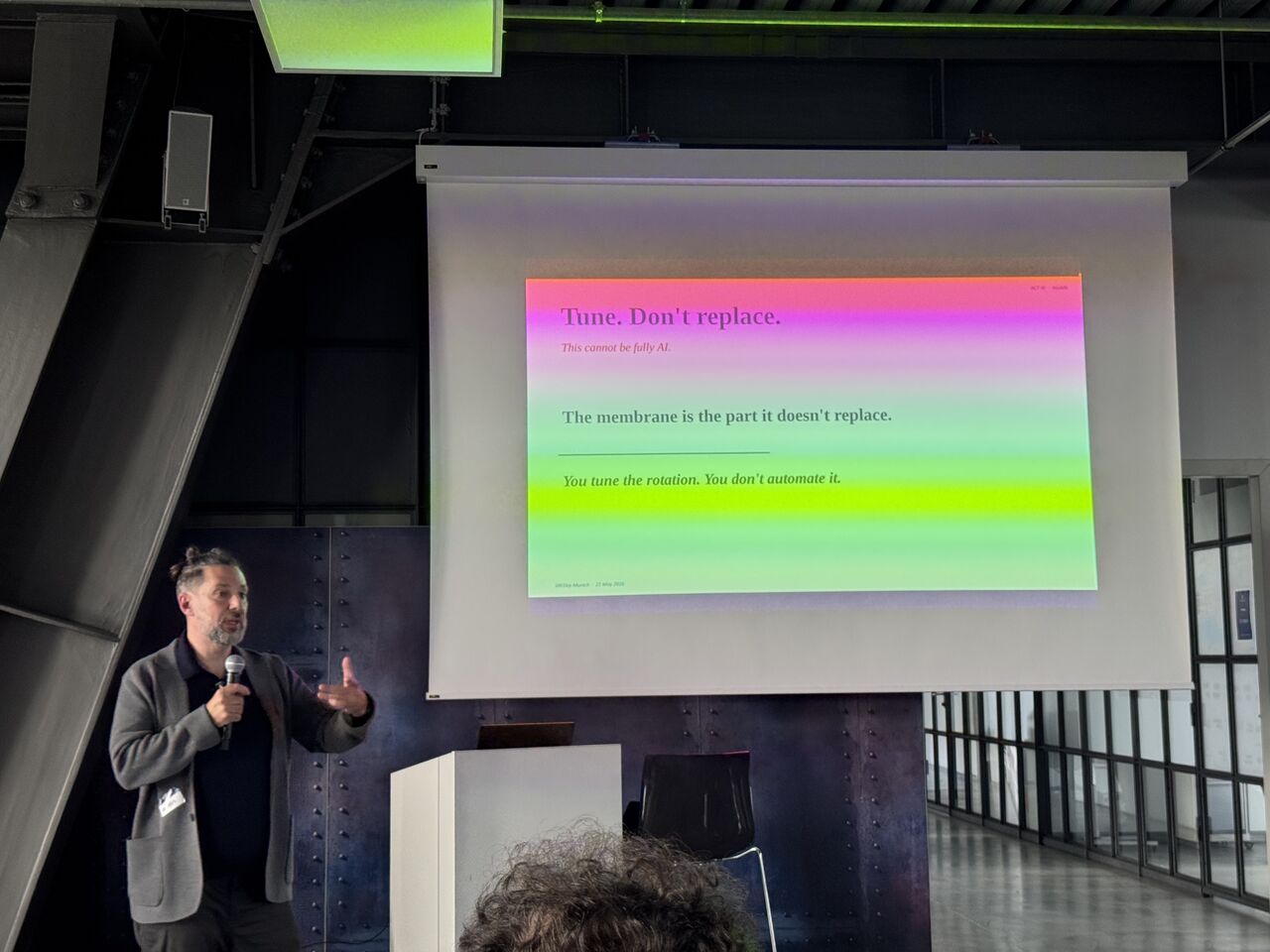
Abstract:
Every week, three engineers on my SRE team take the gatekeeping shift. They absorb everything — every interrupt, every ad-hoc request, every ticket that arrives without context or priority. Everyone else gets to think. It is, as we still say internally, a horrible week.
We’ve been doing it for five years. It is the single practice that changed the team the most — not despite being unpleasant, but partly because of it.
Here’s what we learned: when a small rotation absorbs all the operational noise, something visible happens to the rest of the team. And when you rotate who that group is, something structural happens to the organization. Engineers who have lived through the interrupt storm don’t need to be told why automation matters — they’ve felt it. Documentation gets written not because anyone mandated it, but because the next person arriving to the shift can’t function without it.
We tracked this across 25,498 tickets over five years. Gatekeepers resolved tickets 48% faster than the team average and completed them at a 13-point higher rate. TOIL peaked at 83.9% during our worst year and came down to 44.7% by end of 2025, crossing under Google SRE’s 50% ceiling. The gatekeeping rotation didn’t move that number alone — but it was the practice that made every other improvement possible, because it made the cost of manual work visible to every engineer on the team, one week at a time.
How we implemented it, what broke the first time, what the data actually showed, and why most teams won’t try it — it looks like a productivity tax until you measure what happens to everyone else. You can start this next sprint. You don’t need budget or organizational permission. You need one week, three volunteers, and the willingness to let the data speak.
Tags: SRE, DevOps, TOIL Reduction, Team Practices, Operations
Articles

When the Structure Becomes the Culture
Published: 2026-06-09 · Publication: DevOps.com
Why micro teams and rotation reshape culture, not just throughput, in modern SRE. Small cells re-form around new work every quarter, rotation keeps fresh context interrogating each team’s assumptions, and culture turns out to be something you can route — through the people who carry it. The companion piece to the SD Times article: that one is the membrane at the edge of the org; this one is the membrane inside it.

Beyond the Org Chart: Why Your SRE Team Needs a Membrane, Not a Silo
Published: 2026-05-26 · Publication: SD Times
A silo is a wall — impermeable, a source of bottlenecks and “not my problem” cultures. A membrane is a semi-permeable filter: it lets the right things through while protecting the team’s focus. This piece makes the case for designing SRE teams as membranes, not silos, and how the gatekeeping rotation puts that boundary into practice.
Interviews
Engineered for Change — Link & Think podcast with Ivo Velitchkov
A 59-minute conversation exploring how strategic rotation and cross-pollination build organizations that absorb disruption. Hosted by Ivo Velitchkov on his Link & Think podcast.
Released 2025-09-17.
Key quotes:
“They become irrelevant to an extent because we get so used to change.”
“Share the pain is a key factor. We all have to share that amount of pain.”
“There is all the time a reason to have a conversation on our process.”
Speaker
Andrea Valenti is Senior Director of SRE leading ~40 engineers across multiple geographies. Over six years, three mergers and a couple of divestments, he developed a framework for building engineering organizations that absorb disruption rather than accumulate it. Before technology, he worked as an educator in psychiatric care in Bologna — which taught him more about teams under pressure than any management book. He plays saxophone badly, builds electronic instruments in his spare time, and developed most of this framework between Brussels, Miami, and Mexico City before settling in Barcelona.
Languages: English, Italian, Spanish, French.
For framework background, see About. The narrative companion is on the Download page.